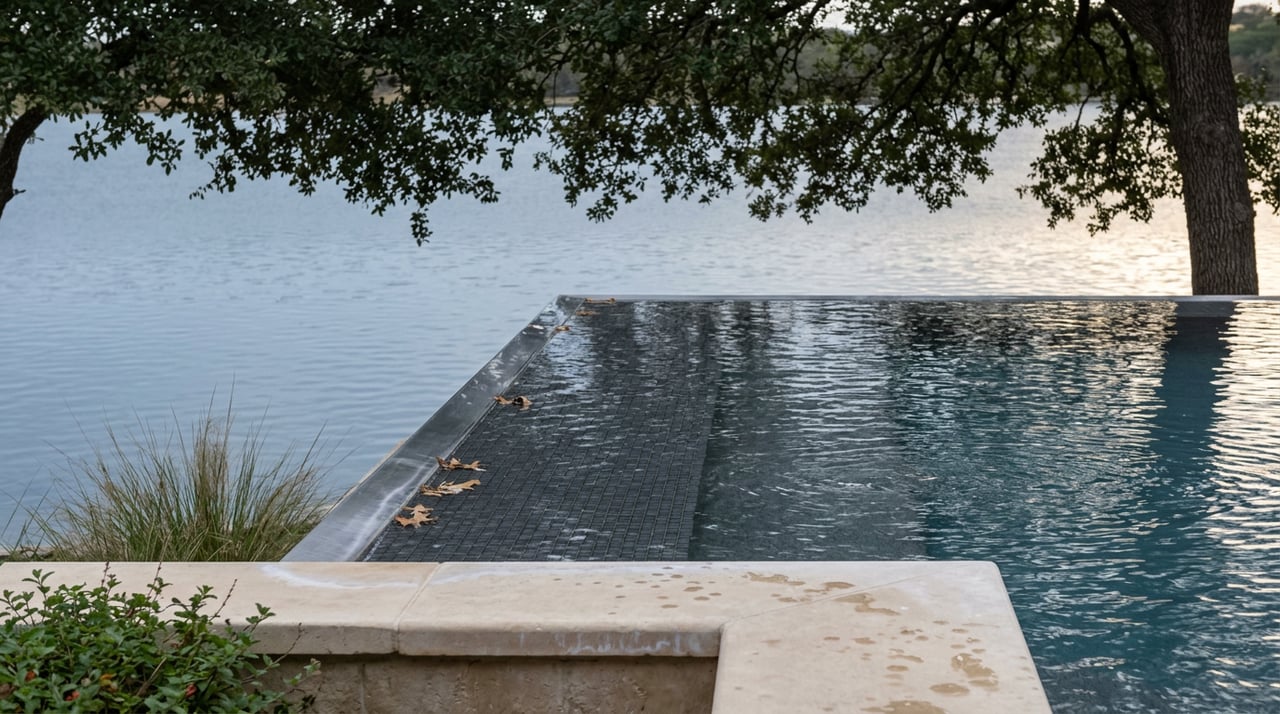
Lake Travis Is Full Again, And Your Drought-Era Habits Are Showing
September 10, 2026
September 10, 2026
Somewhere near the low bluff at Mansfield Dam Park, on a hump of ground that regulars call Sometimes Island, someone once planted an American flag. Nobody remembers who did it or why. It just appeared one dry year, a small joke standing in for the fact that this stretch of exposed lakebed had become a destination in its own right. Boaters would motor out, take a photo standing on dirt where deep water should have been, and call it an afternoon. That flag has not been visible since mid-July.
Lake Travis crossed 681 feet, its full pool elevation, in mid-July 2026. That is the first time it has happened since 2019, roughly seven years of a lake that spent its entire life below that line. Residents built habits around a shoreline that kept receding: the ramp you trust because it never seems to run dry, the cove you stopped bothering with because it turned to mud every August, the restaurant you defaulted to because its dock still had water under it. Those habits are now a step behind. The parts of the lake that only work when there is enough water in them are exactly the parts most people quietly stopped visiting.
Earlier this year, the trajectory pointed the other way. As late as March, the lake sat well below full pool with forecasts calling for more decline under typical spring conditions. By mid-April it had climbed only to 663.3 feet, about 72.7 percent full, still comfortably navigable but nowhere near the mark that changes how the lake feels underfoot. Then repeated rounds of heavy Hill Country rain moved through the Highland Lakes watershed, and the numbers stopped behaving.
| Date | Elevation / Percent Full | What It Meant On The Water |
|---|---|---|
| March 2026 | Roughly 665 feet, projected to keep falling | Ramps holding, but a lot of coves still dry |
| April 17, 2026 | 663.3 feet, 72.7% full | Usable, but shallow-water caution still the default habit |
| July 17-18, 2026 | 681 to 684.7 feet | First full pool since 2019, briefly into flood pool |
| September 6, 2026 | 94.4% full | Settled below the July peak, still the highest early-fall level in seven years |
That jump from a lake still projected to shrink in March to one spilling past its own flood pool threshold at Mansfield Dam by mid-July is the part worth sitting with. Lake Travis rose so fast the LCRA opened two floodgates at Mansfield Dam and kept them open for several days while flows worked through downstream. By September 6, the lake had settled to 94.4 percent full, a step below that July peak but still a level nobody living here has felt in early fall since before the last drought started.
For seven years, Mansfield Dam Park did the heavy lifting. Its four boat lanes and wheelchair-accessible courtesy dock kept working through water levels that shut down shallower ramps around the lake, which made it the default launch point almost by necessity. Devil's Cove and Starnes Island held on for the same reason: they are deep enough that low water barely touched them. Starnes Island in particular became the standing overflow anchorage for tour boats after the City of Jonestown redirected commercial traffic there back in 2011, and that arrangement never really changed through the driest years.
What is different now is everything that used to need real depth to function:
If your mental map of the lake bottom is a few years old, it is worth updating before you plan a Saturday around it. A cove that was six inches of mud in 2023 may be several feet of usable water now, and the reverse assumption, that a spot is still too shallow to bother with, is just as likely to be wrong.
Lakeway Marina has been running out of the Lakeway Resort & Spa since the 1960s, full service, with rentals, party barges, a fuel dock, and one of the larger ship's stores on the lake. For most of the last seven years, that kind of full-service marina absorbed a disproportionate share of boat traffic simply because fewer launch points were viable. Sail & Ski Yacht Club, on the lake's south shore in Lakeway, took a different approach and built multiple ramps at different elevations specifically so members could reach the water at nearly any lake level, a design decision that mattered more during drought than it does right now, because most of the lake in front of it is simply water again.
The practical effect is that traffic which used to bottleneck at a handful of deep-water ramps has somewhere else to go this fall. That is a small thing until you are the one sitting in a launch line on a Saturday morning.
Canyon Grille, perched above the Rough Hollow Yacht Club, closed for a week in April and reopened April 14 under new owner Haythem Dawlett, who also developed the Rough Hollow community and is behind the upcoming Square at Lakeway. The relaunch rebuilt the restaurant around a rotating seasonal menu with Gulf Coast seafood brought in multiple times a week and ingredients sourced from Hill Country farms.
"Our goal is to build something that truly reflects the local culture and culinary expectations."
That is Dawlett describing the reboot, and the timing lines up with a lake that suddenly looks the way it did the last time the restaurant's patio was full every weekend.
A short walk from there, SP Brazilian Steakhouse has been family-run by owner Ileana Salazar for nearly a decade, still putting out a salad bar with more than 34 options and sending servers table to table with 14 cuts of meat, including picanha and lamb chops. Sundancer Grill, at Sail & Ski Yacht Club, keeps its lakeside lunch, dinner, and Sunday brunch rotation going with the same water view it has always had, just with a lot more water in it this year.
None of this is a promise about next spring. Lake Travis is a reservoir managed for flood control and water supply, not a fixed body of water, and full pool is a moment, not a permanent state. The months ahead lean La Niña, and La Niña winters have historically run dry in the Hill Country, with the lake declining in roughly seven of every ten La Niña years on record, including the 1950s drought of record and the 2022 to 2024 stretch most Lakeway residents just lived through.
That context does not undo what changed this summer. It just means the smart approach is to plan the next few months of boating around the lake that is actually in front of you, rather than assume September's number is permanent.
For now, the flag on Sometimes Island is underwater, the ramps that were the only real option for seven years have company, and the restaurant patios overlooking all of it are busier for reasons that have nothing to do with the menu. If you have been away from the lake long enough that your habits still belong to the drought, this is the season to go find out what came back before the rest of Lakeway catches up.
If the fuller lake has you thinking more seriously about life on the water here, whether that means a dock, a different stretch of shoreline, or just understanding how conditions like these actually affect a specific address, Tangela Bailey has been watching this shoreline for years and is glad to walk through what it means for the property you have in mind.
Stay up to date on the latest real estate trends.
Partnering with Tangela, I bring clients a well-rounded real estate experience built on collaboration, knowledge, and care. Together, we combine our strengths to guide buyers, sellers, and investors with confidence and clarity, making each step of the process seamless and rewarding.